Dec 11, 2023
 Mobile Development | South Africa

Mobile commerce has become a central part of how South African consumers research, compare and buy products and services. For businesses, that means the mobile experience is no longer simply a smaller version of the desktop journey: speed, convenience, payments, account access and repeat engagement all need to work naturally on a phone.
A mobile-first commerce strategy does not automatically mean every business needs an app. The right approach depends on how often customers return, which tasks they need to complete, whether the business needs device-specific functionality and how closely the mobile experience must connect with existing systems.
What is mobile commerce?
Mobile commerce, or m-commerce, covers commercial activity completed through smartphones and tablets. This can include mobile websites, ecommerce platforms, dedicated shopping apps, customer portals, digital payments, loyalty experiences and mobile access to account or service information.
Key mobile-commerce opportunities for South African businesses
Make repeat purchases easier
Businesses with frequent repeat customers can use a mobile experience to reduce friction around browsing, ordering, payments and account access. A dedicated app can also keep frequently used functionality readily available without requiring customers to navigate through a full website each time.
Connect loyalty and customer engagement
Mobile applications can combine customer accounts, loyalty features, personalised content and notifications in one experience. The value comes from making useful interactions easier rather than simply adding another marketing channel.
Integrate mobile experiences with existing systems
A commerce app rarely operates in isolation. Depending on the business, it may need to connect with ecommerce platforms, payment gateways, inventory systems, customer databases, ERP or accounting software, delivery services and reporting tools. These integrations are an important part of the technical scope.
Use mobile data to improve the customer journey
First-party usage data can help businesses understand which features customers use, where journeys break down and which parts of the mobile experience should be improved. Data collection should be planned alongside appropriate privacy and security requirements.
When does a dedicated mobile commerce app make sense?
A dedicated application is most useful when customers have a reason to return regularly or when the product needs functionality that is difficult to deliver through a standard mobile website.
- Customers order or interact with the business frequently.
- Logged-in users need quick access to personalised information.
- Loyalty, notifications or repeat engagement are central to the customer journey.
- The experience needs integrations with operational or ecommerce systems.
- The product requires mobile-specific functionality or a more controlled user experience.
For businesses still validating an idea, a focused MVP can be a more practical first step than building every planned commerce feature at once.
Mobile website or mobile app?
A responsive ecommerce website remains important for discovery and customers who do not want to install an application. A dedicated app becomes more compelling when the business can offer meaningful repeat utility, a faster logged-in experience, mobile-specific features or deeper integration with customer and operational systems.
In many cases the two channels complement each other: the website supports broad discovery and acquisition, while an app serves customers who interact with the business more frequently.
Planning the technical side of a commerce app
Before development begins, the mobile interface should be considered together with the systems behind it. Important questions include:
- Where will product, account and order data come from?
- Which payment gateway or ecommerce platform must be integrated?
- Which user roles and permissions are required?
- Will the app need push notifications or messaging integrations?
- Does any functionality need to work offline?
- What reporting, administration or backend tools are required?
- How will the application be maintained after launch?
RocketSoft’s mobile app development work covers the application as well as the custom backends, APIs and integrations needed around it. Flutter is RocketSoft’s predominant mobile stack where a shared iOS and Android codebase suits the project requirements.
Start with a defined scope
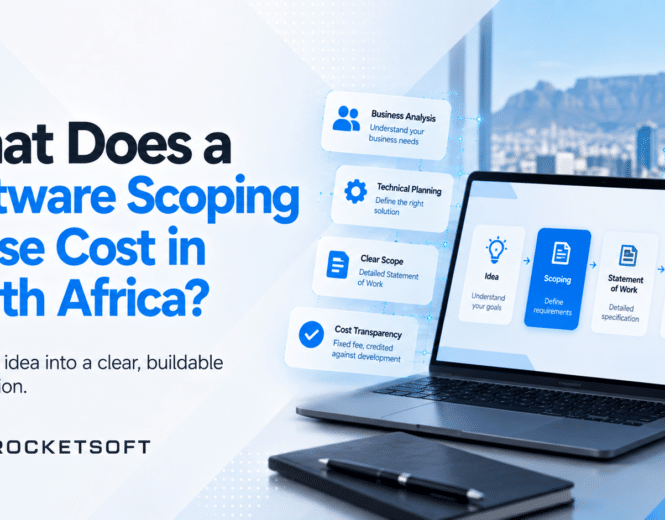
A mobile-commerce project should begin with a clear definition of the customer journey, core functionality, integrations and first-release priorities. RocketSoft uses a paid software-scoping process to turn those requirements into a detailed Statement of Work before the build begins.
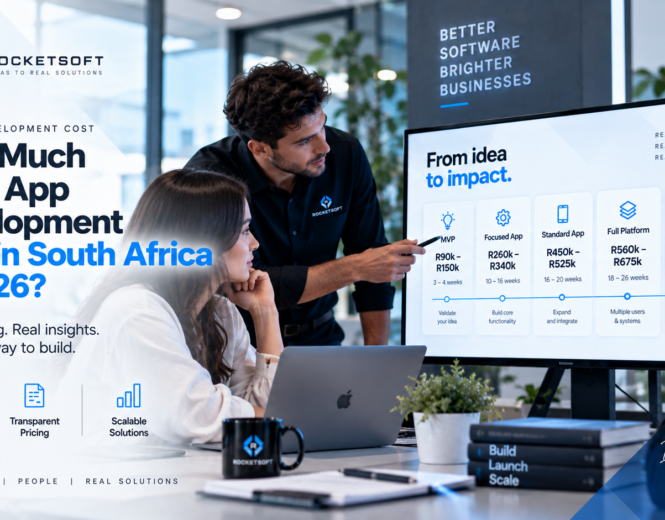
If the first release needs to validate the concept before a larger investment, read more about rapid mobile-app MVPs and mobile app development costs in South Africa.
Discuss your mobile commerce requirements with RocketSoft to determine the most suitable development approach.