 Sep 8, 2026
  Mobile Development | Software Development | South Africa
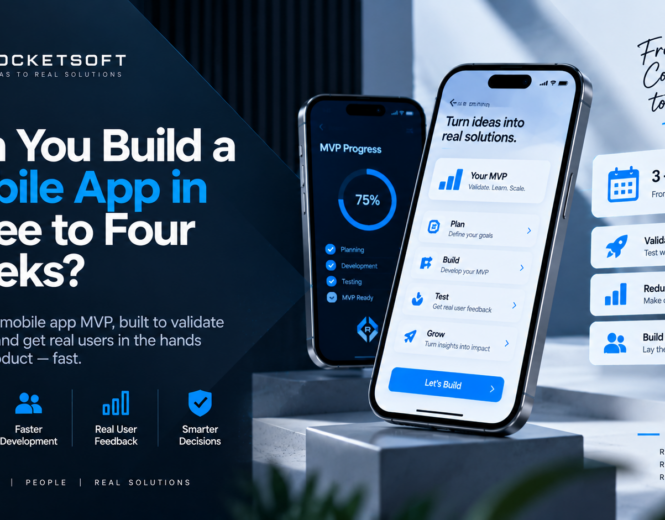
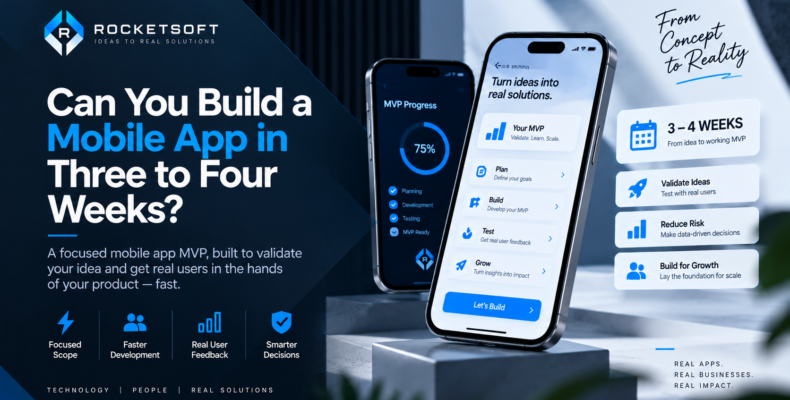
A rapid mobile app MVP in South Africa can be developed in three to four weeks, but only when the product has a deliberately narrow scope.
Based on RocketSoft’s current development model, this type of project normally requires approximately 120 to 200 development hours and costs between R90,000 and R150,000 excluding VAT.
The result is a proof of concept designed to answer a specific business question. It is not a finished enterprise application that happens to have been developed quickly.
RocketSoft’s mobile app developers are based in Cape Town and work with businesses throughout South Africa.
What is a rapid mobile app MVP?
A rapid mobile app MVP is the smallest usable version of a product that can validate an assumption with real users.
Its purpose may be to establish:
- Whether customers will use a proposed service.
- Whether employees will adopt a digital workflow.
- Whether a spreadsheet or WhatsApp process can be replaced.
- Whether an external integration is technically viable.
- Whether an investor or internal committee will fund a larger build.
Effective MVP app development in South Africa should focus on one central question. Features that do not directly help answer that question should be deferred.
What makes a three-to-four-week app timeline possible?
The app development timeline in South Africa depends on both the technical scope and the client’s readiness.
RocketSoft can offer a rapid-MVP timeline when the project meets several important conditions.
An existing backend foundation
Starting with an established Laravel backend foundation removes work that would otherwise be required to configure a new project, user management and common application services.
This is faster than beginning with an entirely blank software repository.
One Flutter codebase
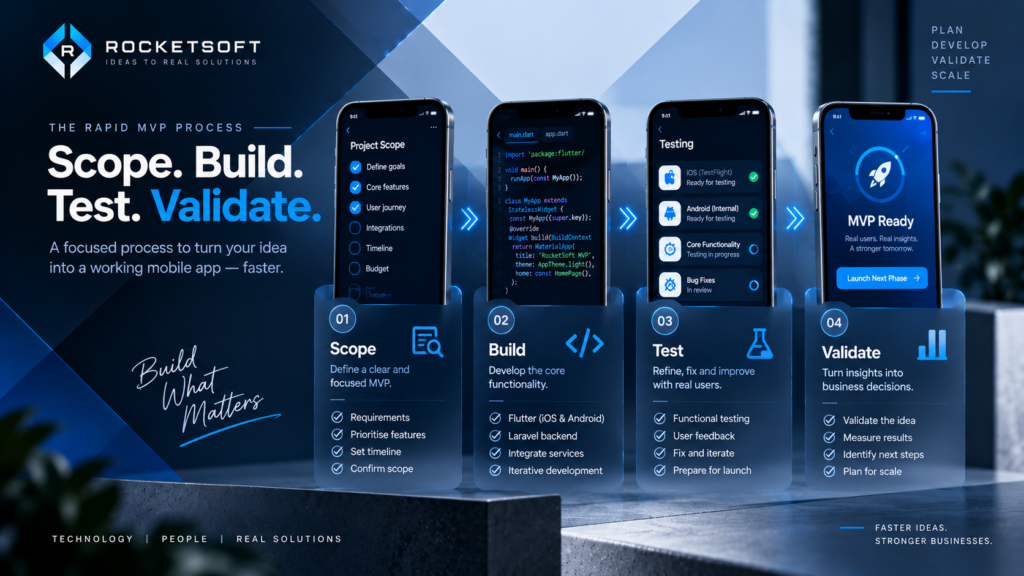
Flutter allows the development team to work from one mobile codebase rather than building separate native iOS and Android applications.
For a rapid mobile app MVP in South Africa, distribution is usually limited to TestFlight and Google Play internal testing. Public app-store release and full production-readiness are treated as later milestones.
One primary user role
Complex permissions increase development and testing requirements.
A rapid MVP should normally have one main type of user and a tightly controlled administrative function.
Standard interface components
The application uses an established component library instead of a completely bespoke design system.
The client’s logo, colours and basic visual identity can still be applied, but advanced animations and extensive interface customisation are deferred.
One documented integration
A third-party integration can be included when the API is documented, tested and accessible before development starts.
If credentials, sandbox access or API documentation are delayed, the app development timeline will also be delayed.
Managed hosting
Platforms such as Railway and Supabase reduce the infrastructure work required for a small initial build.
Bespoke cloud architecture is generally unnecessary until the product’s scale, compliance requirements or existing client infrastructure justify it.
What does a rapid MVP include?
The exact scope depends on the product, but a rapid MVP normally includes:
- One tightly defined user journey.
- One primary user role.
- Essential data capture and display.
- Basic authentication where required.
- Standardised visual components.
- One straightforward integration at most.
- A managed backend and database.
- Internal mobile-app distribution.
- Focused functional testing.
Every included feature must support the specific assumption the MVP is intended to test.
What is excluded from a rapid MVP?
A rapid MVP does not normally include:
- Full offline capability.
- Complicated role-based permissions.
- Multiple undocumented integrations.
- A comprehensive automated test suite.
- Bespoke cloud infrastructure.
- Advanced reporting and analytics.
- Support for thousands of concurrent users.
- Every possible edge case.
- Full public app-store release.
These features can be added in later phases once the business has validated the product’s main purpose.

How much does rapid MVP development cost?
Based on RocketSoft’s blended development rate of R750 per hour excluding VAT, a rapid MVP requiring 120 to 200 hours costs approximately R90,000 to R150,000 excluding VAT.
Before development, RocketSoft completes a paid software scoping phase costing R10,000 excluding VAT. The scoping fee is credited against the build when the project proceeds.
The software scoping phase determines whether the requirement genuinely fits the rapid-MVP tier.
If the application requires multiple user roles, offline functionality, specialist hardware or several integrations, it should be scoped as a larger development rather than forced into an unrealistic budget and timeline.
What does the client need to provide?
The client must be ready to move at the same speed as the development team.
For a three-to-four-week target, RocketSoft requires:
- One named decision maker.
- Decisions and approvals within 24 to 48 hours.
- Branding and content available at the start.
- Third-party credentials available on day one.
- Attendance at agreed demonstrations.
- Prompt user-acceptance feedback.
- No major scope changes after development begins.
When approvals, content or credentials are delayed, the same technical scope may take seven or eight weeks.
For fast MVP app development in South Africa, client availability is therefore as important as developer availability.
Is a rapid MVP ready for public release?
Not normally.
A rapid MVP is designed to validate an idea with a controlled group of users. Before a wider release, the application may require:
- Additional security assessment.
- Performance and load testing.
- Expanded automated testing.
- More extensive error handling.
- Monitoring and alerting.
- Public app-store preparation.
- Additional privacy documentation.
- Operational support processes.
The MVP should be treated as the first evidence-producing phase of a product, not the cheapest version of the finished system.
What happens after the MVP?
Once the MVP has been tested, the business can decide whether to:
- Stop because the assumption was not validated.
- Adjust the product using real user feedback.
- Add the next set of prioritised features.
- Prepare the app for public release.
- Develop a full production platform.
- Connect the app to additional business systems.
A focused first phase can reduce the risk of committing to a large software platform before the business has evidence that users need it.
How should businesses choose an MVP developer?
When comparing mobile app developers in Cape Town or elsewhere in South Africa, businesses should ask:
- Is the MVP scope documented?
- Which features are deliberately excluded?
- Who owns the source code?
- Is the backend included?
- Which environments and integrations are included?
- How will users access the initial version?
- What must happen before public release?
- Can the MVP architecture be expanded later?
- What maintenance will be required?
The lowest quotation is not necessarily the lowest-risk option. A useful MVP must still be built on an appropriate technical foundation.
Frequently asked questions
Can both iOS and Android be tested?
A Flutter codebase can target iOS and Android. For a rapid MVP, distribution will normally remain within TestFlight and Google Play internal testing until the app is prepared for public release.
Can an MVP include an integration?
Yes, provided the integration is limited, documented and accessible before development starts. An undocumented legacy integration is unlikely to fit a three-to-four-week timeline.
Can a rapid MVP be made production-ready later?
Yes. If the architecture and initial scope are planned correctly, production features can be added in later phases after the MVP has validated the main idea.
Is three to four weeks guaranteed?
No. The timeline depends on the agreed scope, availability of integrations and the client’s ability to approve decisions promptly.
Discuss your rapid MVP with RocketSoft
RocketSoft helps businesses determine whether a product requirement can be tested through a rapid mobile app MVP in South Africa or requires a larger initial build.
Contact RocketSoft to begin with a documented scoping phase.
Methodology note: Cost and timeline ranges reflect RocketSoft’s quotation and delivery approach as at September 2026. They are not market-wide guarantees. Final pricing and timing depend on the approved Statement of Work, technical requirements and client readiness.