Sep 23, 2026
 Mobile Development | Software Development | South Africa
The app development cost in South Africa can range from approximately R90,000 for a deliberately narrow proof of concept to more than R1.1 million for a multi-module enterprise platform.
Based on RocketSoft’s quotation and delivery records from 2023 to 2026, a production-focused mobile application with a custom backend more commonly costs between R260,000 and R675,000 excluding VAT.
These figures are not presented as South African industry averages. They are based on RocketSoft’s own project-scoping model at a standard blended development rate of R750 per hour excluding VAT.
RocketSoft is a mobile app development company based in Cape Town, working with businesses throughout South Africa and internationally.
App development cost ranges in South Africa
The mobile app development cost in South Africa depends on the number of development hours required, the complexity of the product and the systems with which it must integrate.
RocketSoft divides recent mobile and software requirements into five broad project tiers.
| Project type | Typical timeframe | Scoped hours | Cost excluding VAT |
|---|---|---|---|
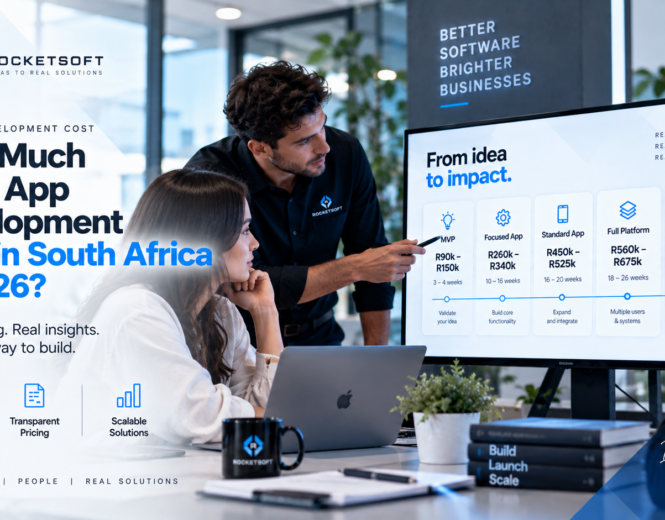
| Rapid MVP or proof of concept | 3–4 weeks | 120–200 | R90,000–R150,000 |
| Focused MVP or single-purpose app | 10–16 weeks | 350–450 | R260,000–R340,000 |
| Standard app with a custom backend | 16–20 weeks | 600–700 | R450,000–R525,000 |
| Full mobile and web platform | 18–26 weeks | 750–900 | R560,000–R675,000 |
| Enterprise or multi-module platform | 9–12 months | 1,500–2,000+ | R1.1 million–R1.5 million+ |
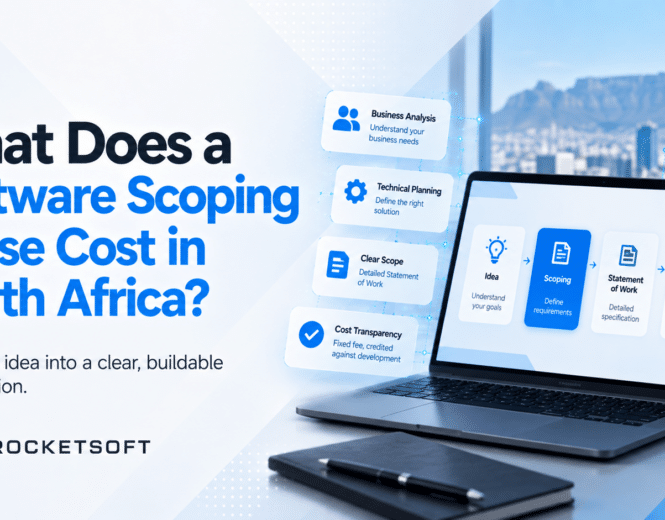
Before development, RocketSoft completes a paid scoping phase costing R10,000 excluding VAT. This produces a comprehensive Statement of Work and is credited against the development cost if the project proceeds.
What can be developed for R90,000 to R150,000?
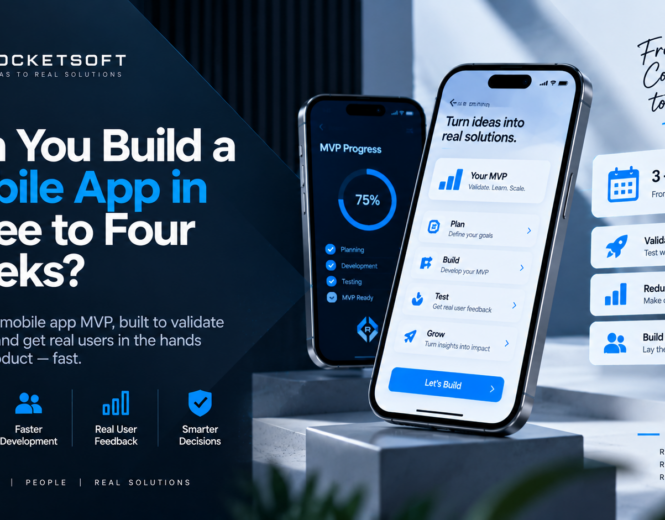
This budget supports a deliberately narrow rapid MVP or proof of concept.
It may include:
- One primary user role.
- A focused set of essential screens.
- Standard interface components.
- A Flutter mobile application using a shared codebase.
- An existing Laravel backend foundation.
- One documented integration at most.
- Managed deployment through Railway or Supabase.
- Distribution through TestFlight or Google Play internal testing.
This tier is suitable for validating an idea, demonstrating a product to investors or testing whether a manual business process should be digitised.
It is not a fully production-hardened application designed for thousands of concurrent users. It normally excludes offline functionality, complex permissions, multiple integrations and a comprehensive automated test suite.
What does a production-focused mobile app cost?
A focused mobile application suitable for continued development generally begins in the R260,000 to R340,000 range excluding VAT.
A standard app with a custom backend is more likely to cost between R450,000 and R525,000. This type of project may include several workflows, a dedicated backend, administrative functionality, user authentication and third-party integrations.
A platform combining mobile and web interfaces, multiple user roles and more complicated business rules generally falls between R560,000 and R675,000.
The final mobile app development cost is determined by scoped hours and technical complexity rather than the number of screens alone.
What increases the cost of app development?
Experienced app developers in South Africa will normally assess architecture, integrations, user roles and compliance requirements before confirming a development price.
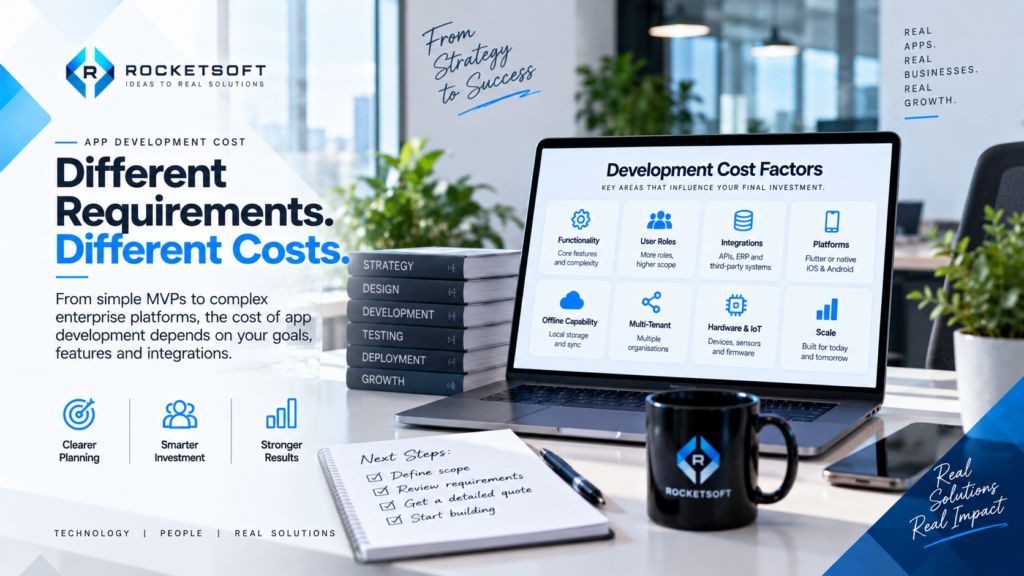
RocketSoft’s quotation records indicate that the following requirements have the greatest effect on cost.
Offline functionality
Offline-first functionality can add approximately 25% to 40% to the development scope.
This requires local data storage, background synchronisation, queue management and rules for resolving conflicting changes. Offline functionality is an architectural requirement rather than a simple feature that can be switched on later.
Multiple user roles
Each additional role can add approximately 10% to 15%, depending on the workflows involved.
A customer, administrator, field worker and regional manager may each require different screens, permissions, reporting and testing paths.
ERP and legacy integrations
Integrating with an ERP or undocumented legacy system can add approximately 15% to 30%.
Much of the work involves discovery, testing and understanding undocumented behaviour rather than writing the connector itself.
Multi-tenant architecture
A system that serves several separate organisations can add approximately 20% to 35%.
Tenant-level data separation, security and configuration affect almost every part of the application.
Hardware and IoT requirements
Bluetooth devices, sensors and specialist hardware can add approximately 15% to 25%.
The development becomes dependent on physical hardware, firmware readiness and testing across multiple devices.
Native iOS and Android applications
Building two separate native applications instead of one Flutter codebase can increase the mobile development scope by approximately 60% to 80%.
The project requires two codebases, two development cycles and two testing processes.
These percentages are based on RocketSoft’s quotation model and should not be interpreted as fixed market-wide increases.
What can reduce the development cost?
An application generally costs less when it has:
- One clearly defined user role.
- A documented third-party API.
- An existing design system.
- No offline requirement.
- A phased delivery plan.
- One available client-side decision maker.
- Content, branding and credentials available before development starts.
Reducing the initial scope is normally safer than removing testing, documentation or technical planning.

What costs are excluded from an app-development quotation?
The initial development is a once-off cost, but operating an application creates ongoing expenses.
Depending on the product, these can include:
- App-store developer accounts.
- Hosting and cloud infrastructure.
- Domain and security certificates.
- WhatsApp, SMS or email messaging.
- Payment-gateway transaction fees.
- Mapping and address-validation services.
- ERP, accounting or credit-checking APIs.
- AI-model usage.
- Security monitoring.
- Software maintenance.
Businesses comparing app developers in South Africa should request clarity on which third-party and post-launch costs are excluded from the initial quotation.
How much should be budgeted for app maintenance?
RocketSoft recommends budgeting approximately 15% to 20% of the original build cost per year for ongoing maintenance.
Mobile applications require updates when Apple and Google change operating-system requirements, permissions, SDKs and app-store compliance rules.
This maintenance may be necessary even when the business does not request new features.
An app that is not maintained can eventually require significant remedial work before further updates are approved or released.
How long does it take to develop an app?
A narrow proof of concept may take three to four weeks, while a standard app with a custom backend generally takes 16 to 20 weeks. Large enterprise platforms can take nine to twelve months.
Elapsed calendar time is longer than simply dividing the development hours by the number of developers.
RocketSoft’s experience is that elapsed time can be approximately 1.5 to two times longer than the raw hours initially suggest. The difference is created by client feedback, third-party access, testing, user acceptance and app-store review.
How do I get an accurate app-development price?
An accurate app development cost in South Africa should be based on a documented scope rather than a short verbal description.
RocketSoft begins with a R10,000 excluding VAT scoping phase. The fee is credited against the build if the project proceeds.
The process produces an itemised Statement of Work covering:
- Functional requirements.
- Technical architecture.
- Development hours.
- Integrations.
- Dependencies.
- Exclusions.
- Acceptance criteria.
- Final estimated cost.
As a mobile app development company in Cape Town, RocketSoft uses this process for projects serving businesses locally and throughout South Africa.
Frequently asked questions
What is the cheapest way to develop an app?
Reduce the initial scope rather than development quality. Begin with one main user role, a focused workflow and limited integrations, then add further functionality after the central idea has been validated.
Can I build an app for less than R100,000?
A narrow proof of concept may begin around R90,000 excluding VAT. A production-focused application with a custom backend normally requires a larger budget.
Is Flutter cheaper than separate native apps?
Flutter can reduce the mobile-development scope because one codebase can support both iOS and Android. Separate native applications require two codebases and additional testing.
Does the development quotation include maintenance?
Maintenance, hosting and third-party services are normally treated separately from the initial build. These ongoing costs should be included in the complete product budget.
About the author: Darryn du Toit is the Founder & Director of RocketSoft and has 18 years of experience in software. The figures and examples in this article are drawn from RocketSoft’s own quotation and delivery records.
Request an app-development estimate
RocketSoft helps South African businesses scope and develop mobile applications, custom software and integrated digital platforms.
Book a scoping call with RocketSoft to discuss your requirements and determine the most appropriate development approach before a detailed estimate is prepared.
Methodology note: Figures are drawn from RocketSoft’s quotation and delivery records for custom software projects between 2023 and 2026. Projects are quoted at a standard blended rate, and the ranges have been banded to prevent the identification of individual clients. These figures reflect RocketSoft’s internal data and are not South African market averages.