 Oct 19, 2026
 Mobile Development | South Africa

App maintenance covers the work needed to keep an existing application usable, compatible and supportable after launch. It can include bug fixes, operating-system and dependency updates, monitoring, backend support and release preparation. The cost depends on the application, the systems involved and the support commitments agreed with your development team.
For a business budgeting for an app in South Africa, the useful question is not simply “What percentage of the build price should we allow?” Ask which work is included, what is billed separately and who is responsible when something stops working. Two apps with similar build costs can have very different maintenance needs.
What does app maintenance usually include?
- Compatibility updates: checking the application against supported iOS and Android versions and addressing changes that affect its operation.
- Framework and dependency updates: reviewing libraries, SDKs and packages, assessing the effect of upgrades and testing before release.
- Bug fixes: investigating reproducible defects, agreeing priorities and verifying fixes against relevant user journeys.
- Backend and API support: maintaining the server-side systems within scope and responding to changes in connected services.
- Monitoring and operational checks: reviewing errors, availability or performance where these are included in the support arrangement.
- Release support: preparing and testing updates, maintaining store information and handling submission requirements.
- Backups and recovery arrangements: defining what is backed up, who checks it and how restoration will be tested where the app depends on managed data or infrastructure.
A maintenance agreement should identify the application, environments and systems it covers. It should also distinguish work performed by the app developer from responsibilities held by your internal team, hosting provider or another supplier.
What affects app maintenance costs?
1. The state of the existing application
A well-documented application with accessible source code and a repeatable release process is easier to assess than a system with missing credentials or unsupported dependencies. An initial technical assessment may identify one-off remedial work before a predictable support arrangement is possible.
2. The number of platforms and integrations
An application supporting iOS and Android needs testing on both. A shared Flutter codebase can reduce duplicated work, but it does not remove platform-specific configuration or testing. Payment providers, maps, messaging services and connected business systems can add dependencies that must be monitored and maintained.
3. Support hours and response expectations
Business-hours assistance and round-the-clock incident cover are different commitments. Define what counts as a critical incident, how it is reported and the expected response. A response target is not the same as a guaranteed resolution time, particularly when another provider controls the affected system.
4. Hosting and third-party charges
Hosting, databases, storage, messaging, monitoring tools and developer accounts may be charged separately from development time. Ask which subscriptions are included, who owns each account and which costs vary with usage. A maintenance quotation should make these assumptions visible.
5. The pace of change
An established application receiving occasional compatibility fixes has different needs from a product that adds features every month. Frequent releases need coordination, testing and a clear distinction between support work and product development.
Maintenance, new features and a rebuild are different scopes
Fixing an agreed defect or adapting to an operating-system change is different from adding a new checkout flow, reporting dashboard or user role. A major framework migration or replacement of an unsupported backend may also need its own project scope. Ask the development team to identify these separately so a monthly maintenance allowance does not conceal substantial new work.
For initial development budgeting, read our app development cost guide. This article focuses on operating and supporting an application after launch; it does not replace a project-specific quote.
Taking over an app from another developer
Before agreeing to ongoing maintenance, the incoming team should assess the app and establish whether it can build, test and release it. Prepare access to the source repository, developer accounts, hosting, APIs and documentation. Record outstanding defects, known limitations and the business-critical journeys that must continue to work.
Access alone is not a complete handover. Clarify ownership and permissions, recover missing documentation where possible and agree which work is needed before routine support can begin. Avoid assuming that a takeover always requires a rebuild, or that every inherited application can be supported without remedial work.
Why responsibility for the backend matters
RocketSoft’s GoReefers driver application integrates with an existing backend maintained by the client’s own development team. It supports operational workflows such as load acceptance, loading information and delivery confirmation. In an arrangement like this, the support plan needs to distinguish mobile-app issues from backend issues and explain how the two teams will investigate incidents together.
The same principle applies to marketplaces. A platform such as RocketSoft’s Meat2Door project includes customer and driver apps, a seller portal and an administration dashboard. When discussing ongoing support for a product with several interfaces, list all the components that require maintenance rather than budgeting only for the customer-facing app.
What to ask for in a maintenance quotation
- The applications, platforms, environments and backend components included.
- Any initial assessment or remedial work, priced separately where appropriate.
- Included hours or deliverables, and how additional work is approved.
- Support hours, incident priorities, response expectations and escalation contacts.
- The process for testing, approving and releasing updates.
- Third-party subscriptions, usage-based charges and whether VAT is included.
- Responsibility for source code, accounts, backups and documentation.
- How the agreement handles new features, major upgrades and future handover.
How much should you budget?
RocketSoft’s published app development pricing guidance recommends an annual maintenance planning allowance of approximately 15%–20% of the original build cost. This is RocketSoft’s budgeting guidance, not a South African market average, a fixed monthly package or a guarantee that every application will fit the range.
For an illustrative R500,000 build excluding VAT, that percentage gives an annual allowance of R75,000–R100,000 excluding VAT, or approximately R6,250–R8,333 per month when spread across twelve months. This is arithmetic for planning, not a quote for a named project. The actual agreement should define included work, response expectations and any separately charged services.
What does it cost to run an app beyond maintenance?
Separate the developer’s maintenance work from the services needed to operate the product. Some provider charges are fixed subscriptions, while others depend on users, messages, transactions, stored files or API calls.
| Budget item | How to assess it |
|---|---|
| App and backend maintenance | Agree included systems, hours or deliverables, response expectations and exclusions. |
| Hosting, database and storage | Confirm the environments, capacity, backups and whether costs increase with usage. |
| App-store developer accounts | Check current platform fees, account ownership and renewal responsibilities. |
| Messaging, maps and connected APIs | Estimate the expected usage and request the relevant provider’s current pricing. |
| Payment processing | Check transaction charges and other account fees with the payment provider. |
| New features and major upgrades | Budget separately unless the maintenance agreement explicitly includes them. |
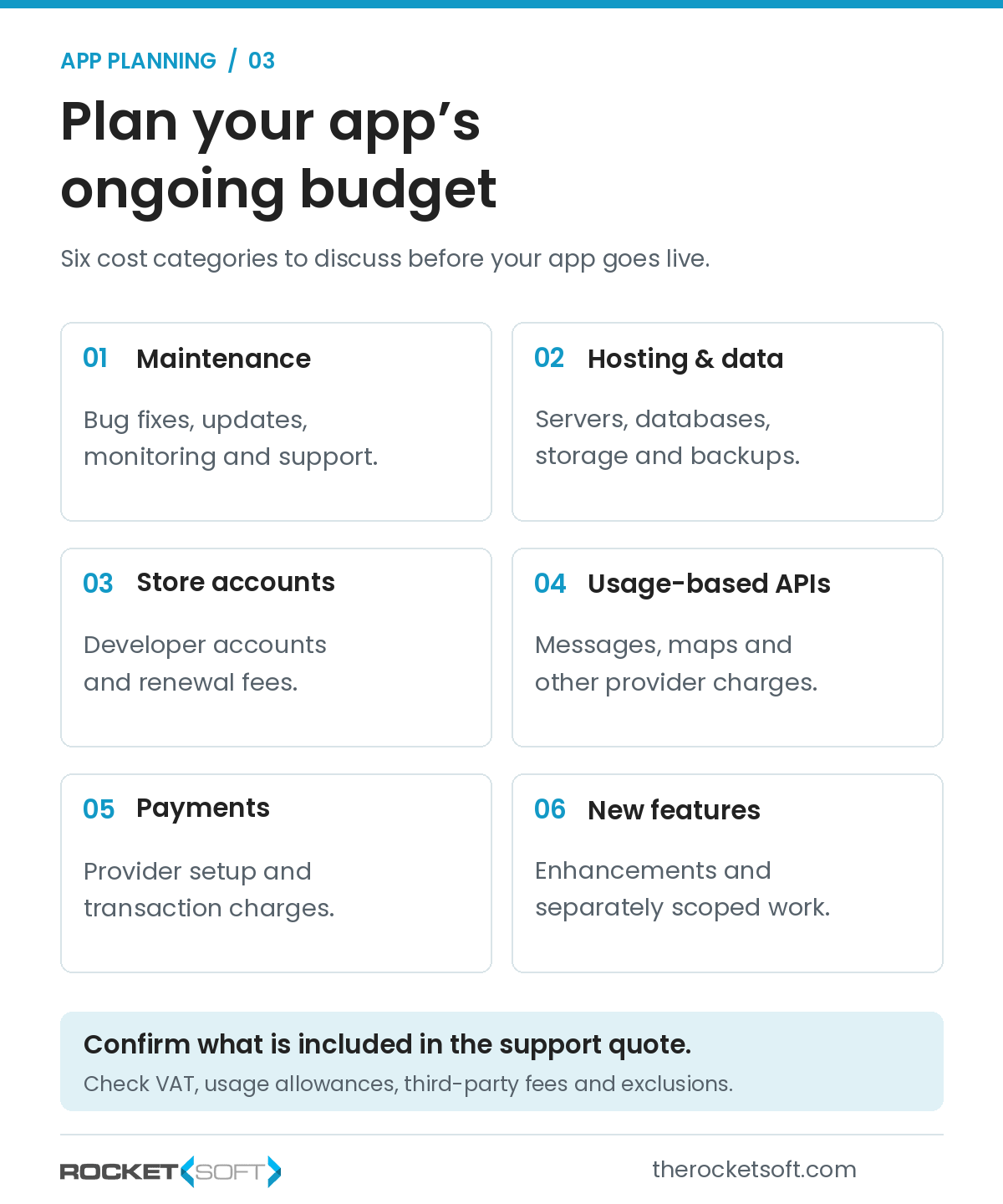
Ask for a budget that lists each category in rand, states whether VAT is included and identifies any provider charges in another currency. Do not assume the maintenance percentage automatically covers hosting, store fees, marketing or substantial feature development.
A practical first-year operating budget
- Confirm the application’s original build cost and support scope.
- Allow for initial assessment or stabilisation if another team built the app.
- Obtain current provider estimates using realistic expected usage.
- Record maintenance, hosting and usage charges as separate items.
- Create a separate allowance for planned feature improvements.
- Review the budget after real usage and support needs become clearer.
An application with limited usage can still need compatibility and dependency updates. A heavily used platform may need more operational monitoring, capacity planning and incident support. Estimate from the product’s responsibilities rather than its download count alone.
Frequently asked questions
Do apps have ongoing costs after launch?
Yes. Depending on the architecture and usage, these can include maintenance, infrastructure, developer accounts and third-party services. Request a separate operating budget alongside the initial build quotation.
Is app maintenance a fixed monthly fee?
It depends on the agreement. Support may be priced as defined deliverables, an allowance of hours or approved work as needed. Ask what unused capacity, urgent requests and extra work mean for the bill.
Does the maintenance allowance cover new features?
Only if the agreed scope says so. New user roles, dashboards, integrations or a major migration may be separate development projects.
Can another developer maintain our app?
Potentially. The incoming team should first assess the source code, dependencies, documentation, account access and release process. Some applications need remedial work before routine support is practical.
Discuss support for your existing app
If you have an existing application, prepare its store links, technology information, known issues and a summary of the systems it connects to. Contact RocketSoft to discuss an assessment and the appropriate next steps. Explore our app maintenance and support service for an existing product, or our mobile app development service if you are planning a new application.