 Oct 12, 2026
 Mobile Development | South Africa
Start with an MVP when the main uncertainty is whether people need the product or will use a proposed workflow. Start with a more complete production release when the business already has a proven requirement and needs the app to operate reliably for its intended audience. The decision depends on what you need to learn and what failure would mean in day-to-day use.
A smaller first version can control the initial budget, but it still needs a clear purpose. The aim is to postpone features that do not help answer the first business question while retaining the testing and safeguards appropriate to the release.
What is an MVP?
A minimum viable product is a focused usable version of a product intended to test an important assumption. For a business app, that might mean checking whether customers complete a booking, employees adopt a digital task process or an integration can support a planned workflow.
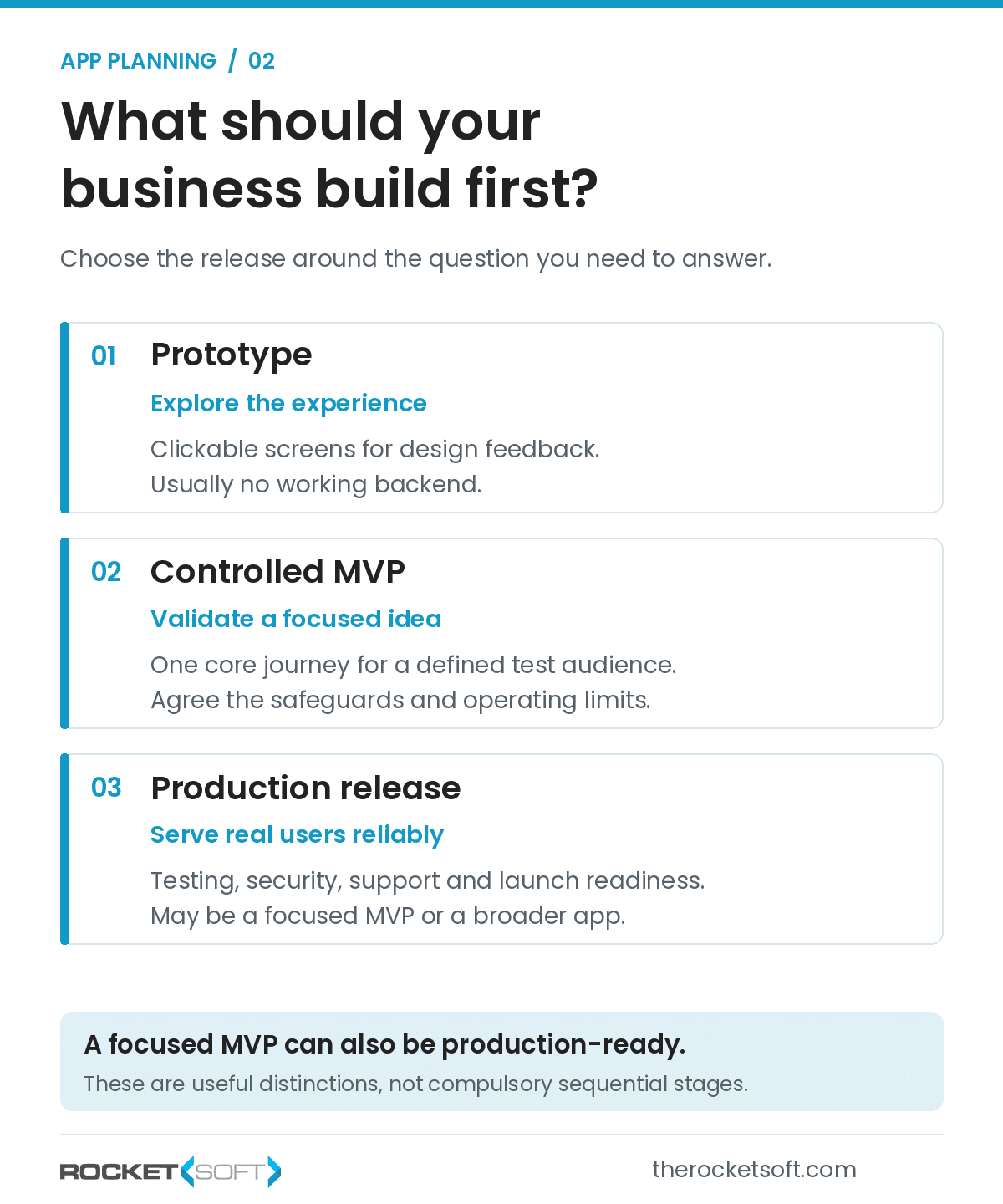
The term is used differently by suppliers. Ask whether the proposed MVP is a controlled validation build or a production-ready first release. Those are different commitments, even if both contain fewer features than the long-term product.
Prototype, MVP and full app: what is the difference?
| Option | Primary purpose | What to clarify |
|---|---|---|
| Clickable prototype | Test the layout, navigation and proposed journey. | It may contain no working backend or live integration. |
| Controlled validation MVP | Test one assumption with a defined group of users. | Which limitations apply and what is needed before public release. |
| Production-focused first release | Deliver a limited but operational product to its intended users. | Testing, data handling, monitoring, support and release requirements. |
| Broader app or platform | Support several journeys, roles or business systems. | Why each feature is necessary now and how the system will be maintained. |
When does an MVP make sense?
- You need evidence that customers will use a proposed service.
- You are testing whether employees will adopt a new process.
- An integration or device dependency needs practical validation.
- The business needs a usable pilot before deciding on a larger investment.
- The first version can operate safely with clear limits and a controlled audience.
Write down the assumption before choosing the feature list. “We want to build an app” does not give the team a useful test. “We want to see whether existing customers can book without calling the office” is a more specific starting point.
When should you plan for a production release from the start?
If the app replaces a business-critical process or will be used by the public from day one, its operating requirements belong in the first scope. Security, recovery, error handling and appropriate testing cannot simply be postponed because the first feature list is short.
An existing business may already know it needs a customer portal or a field-service tool. It can still deliver in phases, but its initial release should be designed around the actual operational responsibilities. A pilot and a production rollout can remain separate milestones.
How does the decision affect the app budget?
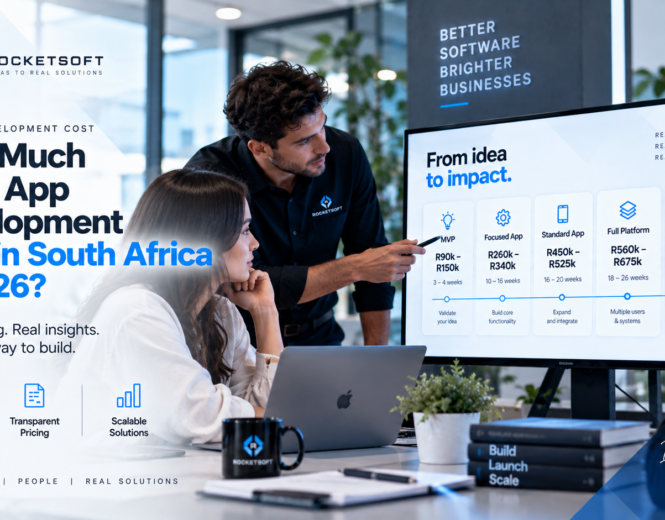
RocketSoft’s app development pricing guide separates different project tiers. Under its published model, a narrow rapid proof of concept is approximately R90,000–R150,000 excluding VAT, while a focused MVP or single-purpose app is approximately R260,000–R340,000 excluding VAT. A standard app with a custom backend is approximately R450,000–R525,000 excluding VAT.
These figures reflect RocketSoft’s own scoped guidance and are not market averages. They describe different amounts of work, not interchangeable labels for the same product. Final pricing depends on the approved requirements, integrations, client readiness and release standard.
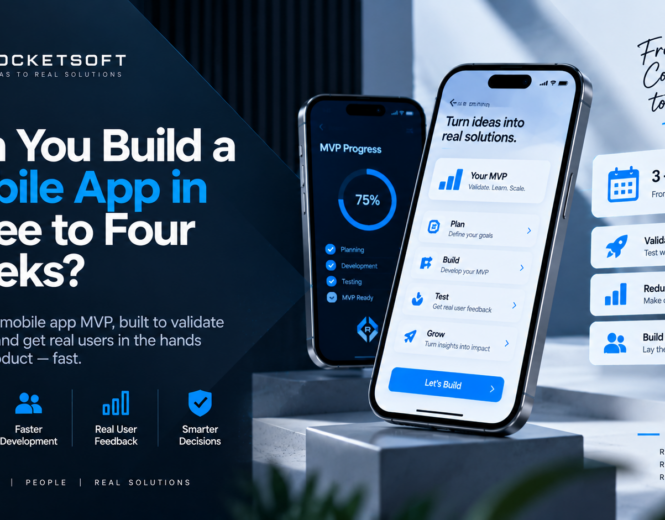
The three-to-four-week rapid MVP approach applies to a deliberately narrow validation scope. It should not be treated as the budget or timeline for every app’s first public release.
Which features should be in the first version?
Include the complete journey needed to test or deliver the first business result. Consider what must happen before and after the visible action, including approvals, exceptions and administration.
For a hypothetical booking pilot, the essential journey might be viewing availability, requesting a slot, receiving confirmation and allowing the business to manage the request. Loyalty points, advanced reporting and several payment options may be later priorities. The exact choices depend on the business; this is an illustration, not a RocketSoft project quotation.
- Essential now: without it, the first journey cannot work or cannot be assessed.
- Operational requirement: needed for the agreed users, data handling or support standard.
- Can wait: useful later but not required to test or deliver the first result.
- Needs investigation: depends on an integration, device or business decision that is not yet confirmed.
Can manual work reduce the first development scope?
Sometimes. A controlled pilot may use a manual approval or export while the business tests demand. Record who performs that work, how users receive feedback and when the process becomes impractical.
Avoid using a manual workaround where it would create unacceptable errors, expose information or undermine the purpose of the test. The appropriate trade-off should be agreed during scoping.
How do you decide whether the MVP worked?
Choose a few measures that relate to the original question. These could include completed journeys, repeat use, abandonment reasons and feedback from the intended users. Set the decision process before launch rather than collecting every available metric.
For an internal app, include the people who use the process and the people who manage it. A completed screen is not enough if administrators still cannot handle the resulting work.
- Who will use the pilot, and how will they be recruited or trained?
- What action or feedback would support continuing development?
- What would lead you to change or stop the idea?
- Who will review the findings and approve the next phase?
- What must be improved before a broader release?
Will the MVP become the full app?
It may, but continuation should be assessed rather than assumed. The initial architecture, code quality and intended validation method affect what can be reused. A design prototype may be replaced entirely; a working pilot may need substantial production preparation.
Ask the developer to document the likely next steps and known limitations. Separate adding new features from improving the operational standard, then budget for both where required.
How RocketSoft helps define a first release
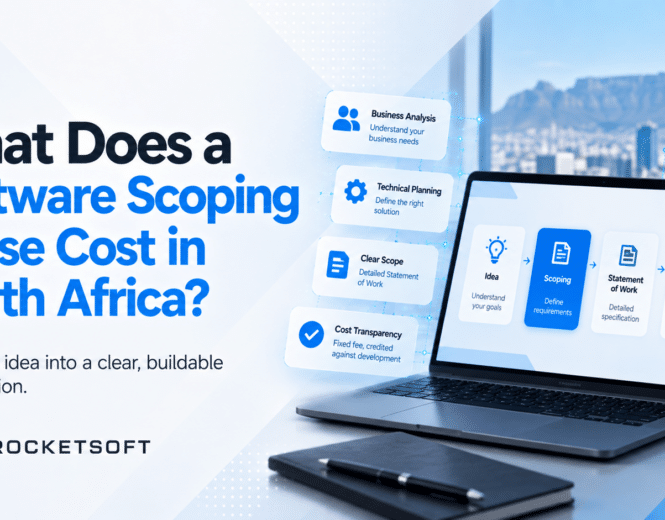
RocketSoft’s software scoping phase currently costs R10,000 excluding VAT. It identifies the requirements, user roles, technical approach, hours, dependencies and exclusions. The completed Statement of Work belongs to the client, and the fee is credited against the build if the client proceeds with RocketSoft.
Explore the MVP app development service for delivery options. For a first discussion, prepare the business problem, intended users, required integrations and a realistic budget range.
Frequently asked questions
Is an MVP always the cheapest way to build an app?
A smaller agreed scope can cost less initially, but it may require further work before wider use. Compare the cost of the first phase and the likely next phase rather than judging only the starting price.
Can an MVP be used by real customers?
It can if the release is scoped for those users and its limitations are appropriate. An internal validation build is not automatically ready for unrestricted public use.
Do we need every planned feature before launch?
Usually you can separate a complete first journey from later enhancements. Keep features that the agreed release genuinely requires, and defer the rest through a documented plan.
What should we do before requesting an MVP quote?
State the assumption you want to test, the intended users, the complete first journey and the decision you will make afterwards. Include integrations and any fixed operating requirements.
Plan the right first version with RocketSoft
Discuss your app idea with RocketSoft to decide whether a prototype, controlled MVP or production-focused first release fits the business. A defined scope helps turn a broad idea into a budget and delivery plan you can assess.