 Oct 7, 2026
 Mobile Development | South Africa
To compare app development quotes in South Africa, first check that every supplier is pricing the same product and release stage. Then compare the included design, mobile platforms, backend, integrations, testing, deployment, ownership and post-launch support. A total price is only useful when those assumptions are clear.
Two proposals labelled “booking app” can describe very different systems. One might cover a mobile interface connected to an existing service. Another might include a custom backend, administration portal, payment integration and public release. The price difference is not meaningful until you know what each proposal contains.
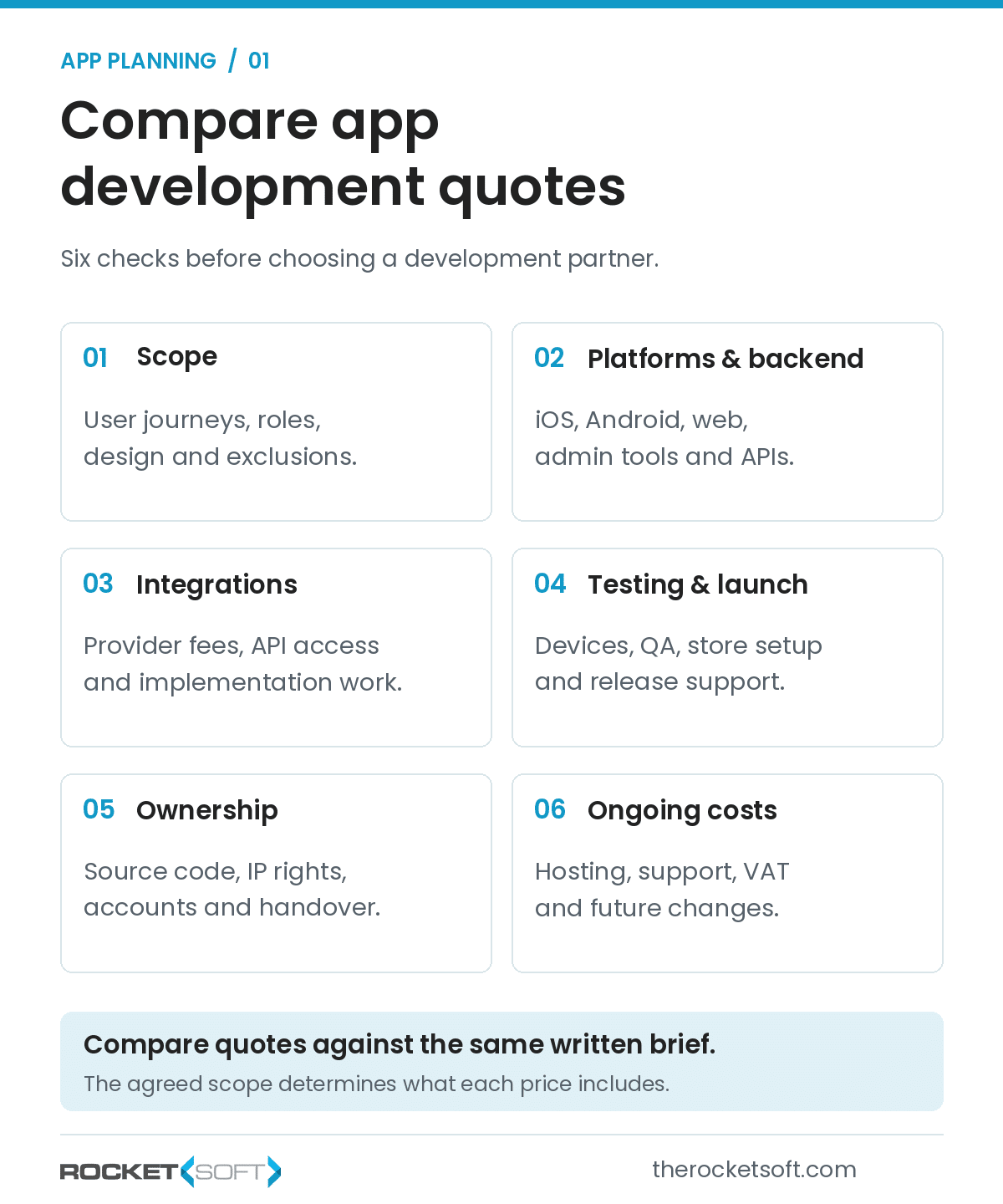
What should an app development quote include?
| Area | Questions to ask |
|---|---|
| Scope | Which user journeys, user roles, screens and administrative functions are included? |
| Design | Are wireframes, interface design, feedback rounds and supplied branding included? |
| Platforms | Does the quote cover Android, iOS, web and the agreed devices? |
| Backend | Who builds and hosts the database, APIs and business rules? |
| Integrations | Which external systems are included, and who provides documentation and access? |
| Testing | Which functional, device and integration checks are included? |
| Release | Is delivery an internal pilot, a public app-store submission or a production platform? |
| Commercial terms | Is VAT included? How are payments, changes and exclusions handled? |
| Ownership and support | What happens to source code, accounts, documentation and maintenance? |
1. Start with the same brief
Give each supplier the same description of the business problem, intended users and first release. Separate requirements you need now from ideas for future phases. Include any existing systems, fixed deadlines and budget constraints.
Ask suppliers to mark each requirement as included, excluded, deferred or dependent on further investigation. This is more useful than expecting identical page layouts or identical technology recommendations.
- Describe one complete user journey, including exceptions and administrative work.
- List every role that needs access and what each role may do.
- Identify the required mobile platforms and any web or administration interface.
- Record integrations, offline requirements and specialist hardware.
- State what the business must be able to do before accepting the first release.
2. Separate a prototype, a validation build and a production app
A clickable prototype helps test navigation and design, but does not need a working production backend. A validation build tests a focused assumption with controlled users. A production release needs an agreed operational standard for the real audience.
RocketSoft’s rapid MVP guide describes a narrow proof of concept at approximately R90,000–R150,000 excluding VAT, under its published scope assumptions. Its pricing guide gives a separate focused MVP range of R260,000–R340,000 excluding VAT. These are RocketSoft’s own planning ranges, not equivalent packages or South African market averages.
If one quote is for controlled testing and another is for public deployment, ask both teams to price the same milestone before making a decision. Confirm what additional work would be needed after the cheaper initial phase.
3. Look beyond the mobile screens
The interface is only part of many app projects. Account permissions, order processing, reporting, integrations and administration can require work that is not visible in a screen mock-up.
For example, a hypothetical service-booking product might need customer booking, staff availability, rescheduling, payment status and an administrator’s view. A proposal covering only customer screens leaves important operational questions open. This example illustrates scope; it is not a quotation or a description of a delivered RocketSoft project.
Ask who is responsible for the backend. If your internal team already provides it, establish the API requirements, testing access and shared delivery dependencies. If the supplier builds it, make that work visible in the quotation.
4. Understand fixed prices, estimated hours and phased delivery
A fixed price should refer to a defined scope. An hours-based estimate should explain the rate, estimated work and approval process if more time is required. A phased plan should identify the deliverable and acceptance criteria for each stage.
Ask whether discovery, design, project coordination and testing are included in the stated hours. Discuss how payment milestones relate to completed work and what happens if an external dependency is delayed.
A contingency allowance and a scope-change budget serve different purposes. Ask the supplier to explain both instead of assuming every future feature fits inside the original total.
5. Check what is excluded and what continues after launch
Request a separate list of ongoing costs. Depending on the product, these may include hosting, databases, app-store accounts, messaging, maps, payment processing, monitoring and maintenance. Some are recurring subscriptions; others vary with usage.
Confirm which accounts your business will own, who pays the providers and whether quoted amounts include VAT. If services are billed in another currency, ask how the budget will be reviewed when usage or exchange rates change.
RocketSoft’s app maintenance and support service is a separate consideration from the initial build. The agreement should distinguish defect cover, maintenance, new features and any initial assessment of inherited code.
6. Ask for evidence of delivery and a clear working process
Review relevant previous projects and ask what the supplier actually delivered. Who designed the interface? Who built the backend? Who manages releases? Comparable workflows and an explanation of the team’s role are more useful than a list of logos.
Use the guide to choosing an app development company in Cape Town to assess communication, team responsibilities, ownership and support alongside the quotation.
A simple way to compare two quotations
- Create a shared requirements list and place each supplier’s response beside it.
- Flag anything that is unclear, excluded or described differently.
- Ask each supplier to confirm the cost of the same first release.
- Separate initial build costs, optional features and continuing charges.
- Compare delivery dependencies, acceptance criteria and ownership terms.
- Choose after the material differences have been explained in writing.
You do not need every line item to be identical. You need enough clarity to understand the business result you are buying and the responsibilities you are accepting.
Why RocketSoft scopes before confirming a detailed build
RocketSoft’s software scoping phase currently costs R10,000 excluding VAT and produces a Statement of Work. The document records the functional requirements, technology, estimated hours, dependencies, exclusions and acceptance criteria.
The completed Statement of Work belongs to the client and can be used to obtain other quotations. The scoping fee is credited against development only if the client proceeds with RocketSoft. Confirm the current terms before appointment.
Frequently asked questions
Why do app development quotes vary so much?
Suppliers may be pricing different features, platforms, backend work, quality checks and release stages. Differences in delivery arrangements also matter. Compare the documented assumptions before drawing a conclusion from the total price.
Is the cheapest app quote the best option?
It can be appropriate if it covers the release you actually need and the supplier can deliver it. Investigate missing requirements and later costs before accepting a low initial price.
Can I get a useful estimate before paying for detailed scoping?
An initial discussion and a clear brief can help establish whether the project fits a likely budget range. A detailed, buildable specification is a separate deliverable. Ask each supplier what it provides at each stage.
Should app-store submission and maintenance be included?
They should be explicitly included or excluded. Submission work, store approval and ongoing maintenance are different matters. Ask who prepares releases, handles review feedback and supports the app afterwards.
Prepare an app brief with RocketSoft
Send RocketSoft a short description of your users, the problem, required integrations, budget range and target launch date. Discuss your project and the appropriate scoping step before comparing detailed build quotations. You can also explore the mobile app development service for the delivery scope.