Sep 16, 2024
 Software Development

Last updated: 23 September 2026.
Custom software makes sense when an important business process cannot be handled well by existing products, or when your customers and staff need a better way to use the systems you already have. For South African businesses considering an investment, the first decision is whether to build, buy or integrate. This guide explains the trade-offs, what to include in your brief and examples of the systems RocketSoft has developed.

What is Custom Software Development?
Custom software is an application built around agreed business requirements. It might be a customer mobile app, a staff portal, a marketplace or a backend that connects several services. Unlike an off-the-shelf subscription, its features and workflows are designed for your project. That flexibility brings responsibility: requirements, testing, hosting, security updates and ongoing support must all be planned. Custom development is not automatically the most affordable or appropriate option.
Benefits of Custom Software Development for South African Businesses

- A closer fit to the workflow
Custom development can reduce compromises where standard software does not support an important process. Validate that requirement with the people who will use the system before building it. - Room to evolve
The architecture can be planned around expected users, data and integrations. Growth still requires capacity planning, testing and maintenance; being custom-built does not make software automatically scalable. - A more useful customer experience
An app or portal can let customers complete a specific task more easily. Define the intended improvement and a way to measure it, such as task completion or fewer manual steps, before assuming it will produce a commercial return. - Security requirements built into the scope
Access controls, data handling, testing and updates should reflect the system’s risks. Custom software is not inherently more secure than an established product: both require appropriate implementation and ongoing care. - Control over priorities and costs
You can decide which features to fund and when. Compare development and ongoing operating costs with subscription alternatives. Hosting, paid components, third-party APIs and maintenance may still carry recurring charges.


When to Build, Buy or Integrate
Start by comparing the work your business needs to do with software already available. Buy when an existing product supports the essential workflow and its licensing, permissions and export options are acceptable. Integrate when the core system works but staff or customers need a connected app or portal. Build when a material requirement cannot be met sensibly by either route. Compare the full operating cost and the consequences of relying on each supplier, not just the initial development quote.
Before asking for a proposal, prepare these four parts of the brief:
- Users and the first useful workflow: who needs access, what they need to do and which features can wait. Separate customer, staff and administrator requirements.
- Existing systems and information: the CRM, ERP, payment, accounting or operational tools involved, the data they hold and whether documented integration access is available.
- Responsibilities and approvals: who supplies content, makes decisions, owns supplier relationships and approves acceptance testing. Identify access or licensing constraints early.
- Success and ongoing support: how the first release will be evaluated, who responds to problems and what budget is available for maintenance after launch.
RocketSoft Examples and How to Scope Your Project
Two examples from RocketSoft’s project experience show why scope matters. A marketplace with several types of user is a different undertaking from an app connected to an established backend. Use the examples below to shape questions for your own project, rather than treating them as standard packages:
- Meat2Door: several connected parts
RocketSoft’s Meat2Door project includes a customer app, driver app, seller portal and admin dashboard, using Flutter, Laravel and PostgreSQL. A multi-vendor cart and order tracking illustrate how customer-facing functionality also depends on operational tools. - GoReefers: extending an existing backend
The Flutter driver app supports load acceptance, container collection, delivery information and confirmation. It integrates with a backend maintained by the client’s team. This is an example of adding a mobile workflow without assuming the existing business system must be replaced. - Scoping before committing to a build
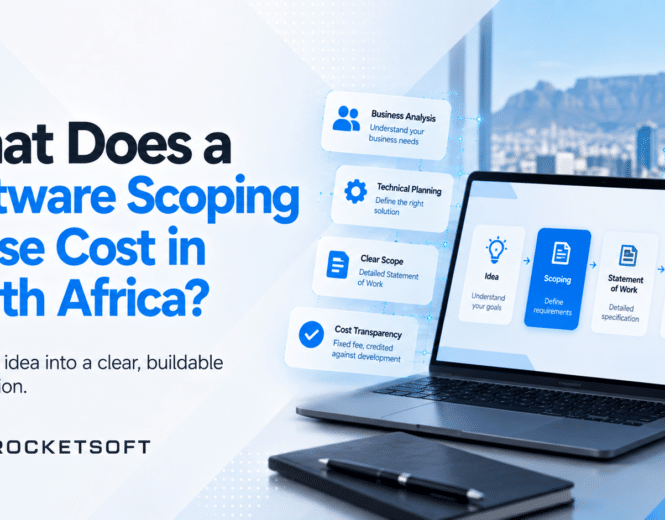
Document the first release, integrations, assumptions and acceptance criteria. Our software scoping guide explains why discovery is a separate part of planning. - Testing, release and handover
Include realistic user journeys, failed connections and permission checks in acceptance testing. Agree who manages production accounts, monitors the system and maintains it after release. These responsibilities should be visible in the proposal.


Budget for discovery, design, development, integration, testing and release, then allow separately for hosting, third-party services, support and future improvements. Ask what is included, what depends on another supplier and how changes will be approved. Agree how source code, accounts, documentation and handover will be handled in the contract. A useful proposal explains assumptions and exclusions as clearly as features.
Planning a custom software project? Contact RocketSoft with the process you want to improve, who will use the system and which existing tools it must connect to. If the main requirement is an app, explore our mobile app development services. A defined first release gives the team a practical basis for discussing scope, cost and delivery.